Showing posts with label creative play. Show all posts

Thursday, January 9, 2014

Guys and Dolls: How a Little Play Violence is Helping my Son be LessAgressive

"Oh, no, Michael!" CRASH! "Mama, my first son just slammed into the wall! He needs to make better choices! That's a bad consequence."

This is the kind of thing I've been hearing a lot since Christmas.  This is not how I originally envisioned my eldest playing with "Michael" a cloth boy doll with soft velvety material for skin and a wry half smile that my son loves, but, it seems to be very therapeutic for him and is shaping his behavior for the better so, I'm rolling with it for now!

I originally got Michael because my son kept talking about the ten sons he wants to adopt someday and support with his job as a photographer (no spouse necessary apparently and how they are going to all ride on the motorcycle he plans to drive is a mystery, but he's four so he has time to figure it out).   I also thought the doll would be handy for role playing now that our second son is crawling around and getting into all our eldest's toys and he's been frustrated by that.  I remember my mom using my dolls in a similar way and trying to substitute stuffed animals didn't seem to have the same results.  I also thought it could be a chance for him to practice the fathering skills that his father demonstrates daily and can take out some of the down time when daddy or mama has to stop games to change brother or soothe him; I thought maybe Michael's diaper could be changed at the same time.  (I remember vividly doing that kind of thing when I was four when my little brother needed attention.). Maybe Michael will get to fill those roles someday, but for now he's primarily a flying scape goat and occasional car violence victim or punching bag.


At first I found the level of violence horrifyingly fascinating. I wasn't sure how to react.  I decided to watch his "play" with Michael to find the "why and what purpose" the play was serving before I intervened with alternatives and the results were fascinating.  Most of my eldest's frustrations with his younger sibling became deflected on Michael.  If I said "pushing your brother down is not a good way to keep him from your toys," my eldest would simply push down Michael, or throw him, or hit him, or kick him before I could even get to asking about alternatives or suggesting alternative interactions with his brother.  Sometimes, the intensity of his anger was a bit scary.  However, after getting his aggression out with Michael, he was much better at suggesting and using alternative behaviors with his brother, so I let him continue.

This course of (in)action seems to be working because, on his own, the interactions with Michael have become less violent as his interactions with his brother improve by the use of new sibling strategies.  There are just days when Michael is in for it, but the important part is that my youngest is now much safer because my eldest is tempted less often to physically lash out at him.

While I still believe in trying to teach my son to use words to get his feelings out, Michael is helping me see that sometimes it may be too much to expect a four year old's language skills and understanding to be adequate enough to get out the intensity of the emotions he is feeling when he is feeling it.  An adult's primary way of playing through emotions may be to talk about it in conversation and tell what happened, but a child's primary way of working through emotions is to physically play it out and then talk about it later.  In fact, it seems like I was skipping an essential step in even understanding my son's emotions when I wanted him to role play "nicely" with me before he'd even had a chance to physically play out and understand the intensity of his anger and frustration. If we adults "need" to play violent video games, play basketball, call a friend or go for a hard run to work through intense stress and emotion, why wouldn't our children also need to do some intense activity to physically let out the stress of what they are working through?  Isn't it the same impulse?  Frustrations with a newly mobile sibling may seem like small potatoes to us, but that's just because it's not new or intense for us.  It is both for my eldest son.  Michael has helped as a tool to work through that.


Michael also gets to provide some wish fulfillment for my son.  While my eldest broke his arm trying to ride a laundry basket down the stairs just a week and a half before Christmas, Michael has made several unsuccessful and successful dare devil antics without getting hurt.  While my son has learned the hard way that he cannot climb furniture, ride down the stairs, or jump off rickety things, Michael gladly does it for him without injury.  This is particularly important because of the restricted activity my son is currently limited to because of his broken arm.  (Something else that must be supremely frustrating and might have been at the root of some of that anger that got taken out on Michael.)

I'd read in Lawrence Cohen's awesome book Playful Parenting that children work through their trauma and their feelings (especially negative feelings or uncomfortable emotions) through play because the fiction of play creates a safe space in which they can explore both the things they have experienced and that which they fear experiencing.  I think maybe Michael is a vehicle through which my son is doing some tough emotional work and if it keeps my eldest son happy and able to deal more positively with his brother and it means that he will never again scare the crap out of me by riding a laundry basket down the stairs, so be it!  

Thanks for reading,
Shawna

P.S. I'm still hoping to see those sweet, traditional doll play fathering moments, too . . . some day.


Thursday, March 28, 2013

10 Days in the Loony Bin--or, Spring Break 2013

Ah, spring break. For NYC public school kids,  it's an unusually long one this year. Seven whole school days off.

As with any major break, I made a plan for what we were doing each day. This way we make the most of the break and we don't spend too much time idle, which starts to drive us all crazy after a while. We are in the middle of our spring break right now, except we haven't done anything on our itinerary, because my two older kids are sick, and the little one has consistent diarrhea (yum. Aren't you glad you're reading this?). No one is seriously ill, just low grade fevers and yucky cold symptoms. But it's enough to keep us quarantined for a few days.

When you're stuck inside with three sick kids, you can get tunnel vision and forget that life exists outside of what's happening right now (which for us thus far has been: fever. Barf. Sneezing. Coughing. Diarrhea. Repeat). I'm all for a little "mommy needs a cocktail" humor, but as I've found myself actually needing a cocktail the last few days, I've decided that I need to change my outlook and my attitude. And I've realized there are many reasons that I'm grateful to be stuck inside with my sick kiddos.

For one, we are getting to spend an inordinate amount of time together. There are tough moments throughout the day, but I genuinely miss my two older kids when they're in school, and it's been so nice to have them at home. They're funny, smart, and endearing, and the days are never dull when they're around. The wonderful way they play together makes up for the amount of fights I have to break up between them. I love hearing them play on their own, too--just yesterday there was about an hour where they were each completely engrossed on their own made up worlds, playing separate imaginative games.

It's also been great not having to run around anywhere. None of our regular classes are running because of the break anyway, but we had social engagements scheduled that would have definitely necessitated that we be up and out the door at a certain time. We have an incredible amount of activities during the school week. In my quest to enrich my children's lives, I run the risk of doing too much. Sometimes it seems as if we never stop running. Much as we love our friends and activities, it's been a relief not having to *be* anywhere but here this week.

The baby has diarrhea, yes--but at least she's still safely in the land of diapers, which means that I don't have to do much except change her. OK, I have to change her three times an hour, but the other plus is that since she's in cloth diapers, all I have to do is wash them--no running to the store for more disposables. Bonus!

When life gives us lemons, we make crafts. We have a whole host of crafting activities that we've been saving for a rainy day, and now we have a week of rainy days! Both the older kids adore crafts and they're always so proud of their creations.

Since I don't have to rush around in the morning, I've shaved my legs twice this week! Yes--my legs do not resemble those of a grizzly bear's. You may not care, but I assure you my husband does. (The older kids watched a show this morning and V hung in the bathroom with me while I showered. Judge me, I don't care. My legs are smooth).

Being home, I've had a chance to do some self-evaluation. The last few months have been a challenge, and admittedly, I haven't been handling the adversity well (see cocktail comment above). I've had plenty of time to think and regroup. Things aren't going to get easier. I just have to adjust my expectations, my reactions and parent my children with love, respect, and remain connected to them, even when things are running amok. I'm grateful to have had the restful time I've needed to make those realizations. There's still a whole week of the break left. I'm still in good health, and will hopefully remain that way--though now that I've pointed it out, I will probably get the plague tomorrow.

If I don't, however, this means that we have plenty of time to get out of the house, see our friends, and go to the park. And when the crazy hustle and bustle starts again next week, I know I will miss these few days when we just hung around and did nothing.

Because sometimes, we need to do just that.


Thursday, May 10, 2012

When Life Gets in the Way of Living


I had a relatively simple childhood. My days were spent playing on my own—in the warm months, creating magical gardens and befriending neighborhood cats, running amok in our backyard, playing with dirt; with sticks; collecting leaves and always promising myself that I’d dry them and keep them in a book (I never did). In the colder months, I spent my time imagining worlds for my Barbie dolls to live in, I read, and I played with my older sister.

There were no such things as dance classes, gymnastics, swimming, or karate for me. We never went on play dates, and my mom never had any other “mom friends” over. That said, I had a stress free, easy-going, blissful childhood. I never worried about being anywhere besides school—I never had a weekly schedule with anything on it other than homework. And I have no complaints.

Oh, how times have changed. As my kids get older and more active, I find myself trying to come up with ways to occupy their time. Don’t get me wrong—we have plenty of fun on our own. But, there are only so many ways we can dress up, only so many books we can read, puzzles we can make, crafts we can create, cupcakes and cookies we can bake; canvases we can paint; play dough we can concoct. We watch TV, but I dislike simply sticking my kids in front of it for the duration of the cold months; and they, and I, need social interaction.

So, we take classes. Lots and lots of classes. Art, guitar, and baseball for my son; dance, animal/nature, art and piano for my daughter. I swore I would never become one of those “We have to go to _____ class today” moms, but I have (oh, and by the way, I could write a book listing all the things I said I or my kids would “never” do).

My husband and I agreed that if any of our kids showed an interest or any affinity for something, we would jump right on it and encourage them in every way possible. We’ve stuck to that, and I’m so happy and grateful that we’ve been able to hone in on my son’s interests and have figured out what makes him “tick” to some extent. He is so happy with art and music; and his dad is coaching him in baseball, which is such an amazing opportunity for the two of them. My daughter is pretty easygoing when it comes to activities, but her interests are clear and she absolutely adores being out and about and enjoys each of her classes. We’ve tried out activities that have turned out to be duds now and again, but I definitely feel that each instance has taught us something.

I do, however, find this way of life somewhat challenging—more accurately, I find keeping the balance between work and play to be a constant worry, and something I have to be acutely conscious of. Being this busy is a slippery slope, and one can quickly forget to stop and smell the roses, watch the leaves turn, watch the snow fall. To take pleasure in simply being—in each day, in each breath. To not let life get in the way of living.

Do I want the type of life where I drive my minivan frantically from place to place, dropping off one kid here and one there? There will come a time when my kids’ day is structured and scheduled to the hour. There will be days when they want to play but will have to do homework instead (in fact, as the weather gets warmer, those days are rapidly approaching). There will be a day when, no matter how much my son loves Little League, he will want to sleep in instead of waking up for 7 a.m. practice on a Saturday. There are days already when my daughter wakes up grumpy, yet we still drag ourselves to music class because we’ve committed to it.

A few months ago I lightened the load of responsibilities that were causing me stress and anxiety but were bringing me little, if any, pleasure. I re-evaluated much of what I was doing with my family and decided we had to get rid of whatever was not making us truly happy. I enjoy being engaged and active in my life; but as they say, life is what happens while you’re busy making other plans—and I don’t want to let mine pass me by.

If living my life is causing me grief, if the day-to-day activities with my children stress me out to the point where I lose my mind, don’t I need to step back and re-evaluate? And do I really want my kids harried and stressed out over missing a class, a playdate, or being late? My sweetest daydreams of spending time with my family include cozy mornings making waffles; hot cocoa by the tree on Christmas day; stopping to jump into a pile of fall leaves while walking through the park; playing catch with the dog; sleeping in; and not doing anything at all.

And yet, I also see myself being buried under sports/music/art equipment. We do schedule activities and go to games, recitals, and exhibitions—and they are a joy. I do see my kids in sports uniforms, holding clarinets, covered in paint. I want our children to do what they love, and love what they do. I them to feel happy, safe, and secure, and know that their home is their haven, the place they can always come back to. I also want them to cultivate their interests, live a full life, and make the most of each day.

Nowhere in my daydreams do I see myself running ragged for anything; being so stressed out over the amount of items on my calendar that I lose my mind. However, despite my best intentions, I do run ragged, run late, and feel like a hamster in a wheel at times. Those are the times that I have taught myself to step back, breathe deep, and evaluate. Whatever is not truly important gets purged.

What difference does it make if my calendar is full but I’m so busy I don’t know what day of the week it is? And if I fill the little boxes in with constant activities, where is the space for fun, for exploration, for time just spent together? What’s the point of “getting everything done” if I’ve lost my temper and yelled at my kids and my spouse?

Years ago, I used to look at my life from the outside—like a picture, I wanted it to look perfect, pretty, and well organized. Now, I remind myself to live my life on the inside—realizing that the picture many not always look perfect, but knowing that what I fill the blanks in with is important.

So far, my boxes are full of the things we enjoy, while leaving space for us to breathe, have fun, and simply live. And I’ve discovered that what may look empty from the outside is more fulfilling than any pretty picture. 


Sunday, April 1, 2012

Sunday School: Pure Play

Welcome to the Connected Mom Sunday School. No matter what the course of your child's education, be it unschooling, homeschooling, or conventional schooling, The Connected Mom Sunday School aims to provide you with fun and easy activities for children of all ages and stages. Have an idea for a Connected Mom Sunday School activity or theme? Either comment below or send your idea to connectedmom (dot) julian (at) gmail (dot) com.)

A few weekends ago at a homeschool conference, I was privileged to hear a talk by Peter Gray, research professor of psychology at Boston College--and the author of one of my favorite education blogs. I had to duck out early due to a family concern, but not before I learned about a troubling trend: research has shown a steady increase in childhood anxiety and depression as opportunities for free play and expression have declined. Historically, kids have learned through self-directed interactions with their world. Is it possible that keeping them constantly busy with adult-directed activities contradicts their nature? Could we be unintentionally harming our children's emotional wellbeing?

With this fresh in my mind, I cannot bring myself to highlight structured activities. This week, I will not describe any specific project. Instead, here are some suggestions for facilitating child-directed play. Set up the opportunity, then sit back and marvel at where your child's imagination will go.

Toddler

Playing with Light

If you haven't checked out Play at Home Mom, I highly recommend it. These moms share all sorts of fun activities to expose your kids to new sensory experiences. One tool they often use is a light box or light panel. The simplest DIY version simply consists of a string of white Christmas lights inside a clear storage bin. You can see that light box, along instructions for a more complex version, at their website. Kids can use a light box with all sorts of small items; transparent or translucent items work really well. You might set out transparent building blocks, colored films, or jars of colored water. Now, you might ask "Isn't this activity parent-directed?" Not really. The moms lay out the activities in a way that attracts the childrens' attention--they call it an "invitation"--then they allow the kids room to experiment.


Preschooler

Busy Bags

Busy bags contain small, self-contained activities to occupy toddlers. Some activities may be more structured, such as tracing letters or matching colors. There's nothing wrong with that, but since this post focuses on child-directed play, I'll share a few of the more open-ended ideas:
  • About 20 twist ties in a small bottle: Kids can twist them, straighten them, build sculptures, or drop them one-by-one into the bottle.
  • Face feature magnets: Clip pictures of various facial expressions from magazines or from the Internet, stick them to magnetic sheets, and cut out. Store them in a small tin. Kids canuse them to make all sorts of silly faces.
  • Velcro shape sticks: Attach small pieces of velcro to the ends of several craft (popsicle) sticks. The original idea has you color code the sticks to form specific shapes. For a more freeform version, Iwould skip that part and let kids build whatever they can imagine.
  • Play dough and small cookie cutters.
  • Colored pasta or beads and string or pipe cleaners to string it on.

These are nice because you can throw them into your purse or diaper bag and pull them out at times when your toddler must sit and wait (at a restaurant, for example). The activities allow your toddler's mind to wander and play, even when his body cannot. If you really want to encourage free play, take two or three activities along and let your child choose one.

School-Age

Create Your Own Fantasy Land

With a few items from around the house, your child can create an imaginative setting for pretend play. Legos, boxes, or blocks become buildings. Use other household items to complete the landscape. A shallow bowl could make a lake or an oatmeal can a cave. Your child can act out any number of scenarios in his fantasy land using toy cars, animals, people. (This is one of many great ideas from Kathy Eugster. See the rest at her website.)

Older Child (10+)

Playing with Technology

Media seems to have an undeserved bad reputation when it comes to free play. But not all screen time is created equal. In fact, technology opens up all sorts of new creative avenues for kids to explore. Both Carnegie Mellon and MIT have developed simple programming languages (Alice and Scratch, respectively) especially for young people. Kids and teens can create their own interactive stories, simple computer games, and more. Programming not your child's thing? Maybe she'd like to produce a video. Set her loose with a cheap video camera, then allow her to edit the footage on the computer. Both Windows and Mac operating systems come standard with a video editor.


Saturday, November 5, 2011

How to Prepare for Life: Play


I spend a lot of time reading and researching preschool education. Even after my husband and I decided we wouldn’t participate in the rat race that preschool education entails in New York, I still spend a lot of time reading about how preschoolers learn, or why they need play, arts, crafts, exercise, and to self-direct their play and interests. I even read up on the preschool methodologies, the Waldorf, the Reggio Emilia, the Montessori, the unschooling, the basic play based and so on. Aspects of each school of thought resonate with me, but what I eventually realized was that I want my children to play and have good experiences as children. I know the schools will stress reading, writing, math, and social studies. I don’t know that they will teach him creativity, or how to explore and experiment in the world on his terms.


When I watch my three year-old son play, I watch him assimilate the world around him. Generally, his favorite toys are not toys at all. He has an old office phone that he uses to pretend to call for a taxi to take him to the Fort Greene playground. One day last week, our corkscrew also served as a pretend phone that he could use to order himself a vehicle and take-out sushi. Earlier this week, he carried around a ladle and serving spoon in his backpack. In the bath, he makes pretend ice cream and tea with the few remaining cups of his infant stacking cups. The lid from the orange juice bottle becomes a muffin he serves me with my “tea.” I gave him foam letters to play with in his bath only to watch him sort them by color, count them, and then put them away. The next night he took his Hot Wheels Carrying Case into the bath and put his letters in the spaces where the cars go. This morning he held up a piece of leftover ribbon and asked, “Can I play with this?”


While he has letters and numbers in his bath and had letters and numbers on the fridge as magnets (before they got lost to the Toss and Scatter game), we don’t quiz him on what they are or what sound they make or what have you. It’s purely about surrounding him with them and letting him explore them on his terms.

Whether it’s in play or education, my husband and I believe in him self-directing his experience. I don’t know exactly what he learns by sitting in a cardboard box and steering while holding a corkscrew to his ear (other than very bad driving habits undoubtedly learned from New York City cab drivers), but I know it’s important to him – otherwise, he wouldn’t do it. Given that he’s three, I trust that he can learn something from everything he does.


Everything I’ve read about how three year old children learn, from David Elkind’s Miseducation: Preschoolers At Risk to Alison Gopnik’s The Philosophical Baby, says it’s completely inappropriate to push early reading or math skills on your children, that in the first years what is most important is their social and emotional development, that kids can learn curriculum anytime, but social and emotional experiences to a large extent get hard wired at this stage, and you only get one shot at hard wiring. However, the more I read up on the schools around me in my neighborhood and city, after I read the catch phrases that we’re all familiar with (play based, encouraging creativity, diverse experiences, nurturing environment, etc.) I found that many of the preschools still mention their program will prepare children for school. Even if on the outside it looks like the kids are just playing, they really are gaining reading readiness skills or learning simple addition and subtraction or what have you.


I assume I find this information on preschool websites, school tours, and brochures, because more than one parent voiced their concern that if they allowed their kid to play all the time, how could they possibly be ready for school. Or will their child be behind the other kids who didn’t play all day? Yet I felt confused; if all the research (I’m finding) says young children need to play and pushing curriculum too young can backfire in their social and emotional development as well as their interest in school and learning, then why are the preschools in my area reassuring parents that their child will probably be phonetically reading by age four?


This month’s Scientific American Magazine has an article, “The Death of Preschool” by Paul Tullis focusing on specifically this question. Academics vs. free play in preschool has been a debate among early educators for decades (Silly me. When I started researching all this preschool stuff, I thought it was a recently new concern in early education), and now, as Tullis maintains, there’s research to prove that play is the absolute best way to nourish young children’s educational lives, yet the trend in schools continues to push academics.


I can understand the urge to push academics on young children. I can understand that parents want the best for their children and to have all kinds of opportunities available to them, and one way to get those opportunities is to do well in school. I can understand that no parent wants their child to struggle to learn or experience the feeling of being behind one's peers (or god forbid label themselves as "dumb"). Yet I have to admit, I am left wondering why is it parents don’t trust that interacting with their children is enough to prepare their child for school? Many states now do test children to make sure they’re ready for kindergarten, but isn’t this “being prepared for kindergarten” thing getting a little out of hand? Even those of us who say we don’t push academics on our children still defend our play-focused households with anecdotes about how our kids learned their letters from the subway or that when they break their crayons, they say now they have two crayons, so clearly they are learning math and basic addition. If we were truly play based, we wouldn’t need some result of playtime to reassure ourselves that our children are learning.


The truth is, what impresses me about my son is not that he knows the alphabet or how to count or that when you break a piece of chalk, you then have two. What impresses me is that he can walk into a Starbucks and intuitively know that the bathroom is in the back and walks in that direction when he has to pee. It impresses me when he tells another child on the playground, “That’s not playing nice” or that he doesn’t want to play rough. I’m constantly impressed with his creativity, like how he takes a bunch of pennies and throws them on the floor as he yells, “Money thunder!” and I think, yes, that’s what I want you to do in school, to take two separate ideas and find a way to link them. Today, my son was ill, and my husband and I were impressed that instead of whining or throwing a tantrum, he just went and put himself to bed. The truth is what impresses me about what my son learns and has learned are the things that can’t be measured on any test. While they all contribute to him developing as a human being, I don't know that they are necessarily "preparing" him for kindergarten. But these are all skills he learned from interacting with my husband and me and from playing. So if our children are already learning how to engage with the world from us as parents, playing, and just experiencing life, why can’t we trust that they’ll also learn whatever they need to learn to be ready to start school?


Wednesday, December 8, 2010

5 Easy Activities for Indoor Fun

Winter is upon us and that means little ones stuck at home with a lot of energy to expend.  Here's some fun, easy ways to pass the time when the weather has you inside.  So whether it's raining, snowing, or just too
darn cold to go out, there's still plenty of things to do inside!


1.  Puppet theatre

You will need:
- an old curtain
- a bistro curtain rod
- stuffed animals
- a silly toddler

No sewing necessary!  Just run the curtain along the rod and flip the extra length over the rod.  Your child will entertain himself (and you) for hours!

Sunday, October 10, 2010

Fostering creativity in kids

I was perusing the Cotton Babies site today, the home of BumGenius diapers and stumbled upon the question: How do you encourage a creative, artistic spirit in your baby, toddler or young child?  Creativity is paramount in my family.  My mother is an oil painter as was my husband's grandmother.  We both grew up around creative spirits and we love art galleries, concerts, films, and plays.  My own experience shows me how art and creativity helps solve problems, create connections, and inspire emotional development, so we've tried to encourage our children by fostering their own creativity.


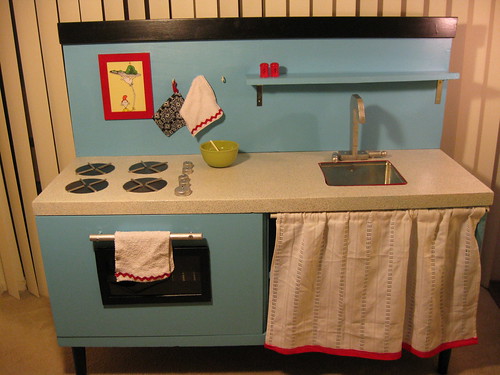
We started by creating an inspiring environment.  Drawing off resources like freecyle and craft stores, we've created a bedroom ripe for imaginative play and creativity for less than $50.  Our son can cook up dinner in his kitchen for us, or draw pictures in the small art station, or curl up to enjoy imaginary worlds on his homemade bean bag.  We imagined the coolest room we could have had as children and made it happen, stocked with crayons, colored pencils, blocks, and imaginative toys.


Living in a large metro area, we try to seek out local cultural events.  My kids love the music and costumery that accompany many countries' traditional ceremonies and it's wonderful exposure to the creativity and originality of world cultures.  Try looking for local magazines that keep trackof upcoming events in your area and take advantage.

Take a day and visit a children's museum near you.  These museums often offer a variety of hands-on, learning activities as well as arts and crafts room.  If you are lucky enough to have a local museum, see about supporting them through a family membership and organize a meet-up with other parents and kids.  Giving kids a creative environment and the fresh perspectives of other children their age can inspire kids to think outside the box.  Children connect over art.

Encourage their creative endeavors by giving them a gallery to show off their latest creations.  Consider hosting an open house for family members where you display their drawings, paintings, and crafts.  Not only will Grandma and Grandma get a kick out of seeing their excitement, it will help them articulate how they feel about their art, creating emotional connections with the place it has in their lives.


And parents don't foget to get messy!  I mean you not just them.  The best way to foster creativity is to get down and dirty with your kids - fingerpaint, jump in rain puddles, dress up and put on a play.  Playful parenting helps kids work through the emotional and developmental stresses growing up comes with in a healthy way.  The best we can give them is time to play.

Thursday, May 6, 2010

Kid's dream playroom - inspiration board

Last summer, I started working on a lot of handmade toys for James.  Then I got pregnant and morning sickness took over our lives.  So here is my inspiration board for our play room.  Maybe I can undo the tv addiction and encourage more creative play :)

From Out of the Crayon Box

From Homemade by Jill

Lots of fun food
A felt play house
Like from This & That

more to come :)