Saturday, June 5, 2010

Why Can't We Be Friends? The Breast Feeder v. Formula Feeder Dilemma

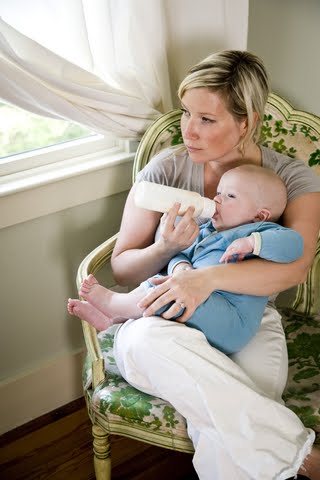
Tonight I happened upon the blog, Fearless Formula Feeder, and it got me thinking about the breastmilk v. formula war that has been raging as long as I can remember. I found myself wanting to dislike it. I wanted to want to chastise the mom behind it. Rather I found myself feeling sort of disinterested or rather like a Conneticut yankee in King Arthur's Court. It really wasn't meant for me.  The only thing I really took any objection to was the use of the term "factivist," but to be honest, I didn't take enough time reading the site to get the full story on it.

Rather I found myself pondering the line that's been drawn in the sand separating formula feeding moms and breastfeeding moms. Somewhere along the line we've started fighting each other rather than focusing on the root of the problem. I know this isn't always the case, but it strikes me that moms are perpetually on the defensive about how they feed their babies whether they're defending their right to nurse in public or their decision to formula feed. As a lactivist, I operate under the assumption that breastfeeding is best and I work to promote it as much as possible. As a mother, I know it's not always so easy.

Most breastfeeding advocates I know focus their fight on normalizing breastfeeding as well as attacking unethical practices on the part of formula companies. While doing so they often reference facts about the health benefits of breastfeeding. A good deal of the lactivist agenda is aimed at promoting the rights of the breastfeeding mother to nurse where ever and when ever they want, and promoting breastfeeding by trying to change formula marketers underhanded tactics meant undermine nursing relationships. I don't think the intention is to shame moms who wind up formula feeding; however, this is certainly an effect of lactivism.

I said before that I work to promote breastfeeding. I write about it, I nurse in public, I have a bumper sticker. But more than all the advocacy, I also offer my number to anyone with the express instruction to call day or night. I've offered to go to other mom's houses. I've answered questions on facebook and twitter. I don't say this to toot my own horn. I'm telling you this because I think the crux of the issue really lies outside of advocacy and debate. As a lactivist, when I hear a mom say she "couldn't breastfeed," I don't roll my eyes or give dirty looks, I immediately jump to wondering what went wrong. Did they have good support? Was there an issue with a c-section/medication? Were they given poor advice by a physician? Could I have helped them with latch? There's a laundry list of thoughts that run through my mind, and it's frustrating to me because, thanks to social media, so many moms I "meet" live across the country. I can only do so much online. Often these moms express remorse about not being able to breastfeed. Sometimes they even express hope that they can nurse their next child.

So it saddens me that this has become an us versus them issue. The thing is that I don't think most lactivists want to alienate formula feeding mothers. In our minds, we are taking on society and big business. Unfortunately, formula feeding mothers feel our advocacy more keenly then the CEO of Nestle. Believe me, he does not care what we have to say. The shameful marketing tactics of his company prove it. The mother who struggles with breastfeeding, whose physician offers formula, who wants to feel like she is feeding her child feels the attacks.

So what do we do about it? Why can't we be friends? Well, the first step is not jumping to judge formula feeding mothers. Instead, engage them in a conversation about why they use formula. Now I know this sounds uncomfortable, and it's a fine line to tread. But if you can show honest interest and openness, in my experience, the conversation is beneficial to both mothers. I know having this conversation has cleared tension in some of my mom friend relationships. The second step is to step off the soapbox occasionally. Now I love my soapbox, but real change doesn't occur from words alone. Offer your support to a mom who is struggling. Tell a friend who wants to breastfeed her baby to call you whenever she needs you. Be available for support to anyone who needs it.

I still believe breastfeeding is best for baby, but rather than preaching it all the time I want us to rethink how breastfeeding fits in our society. Yes, it's key to normalize nursing. It's important our children see breasts as for babies. It's vital moms feel comfortable and supported nursing in public, and we need to hold formula companies accountable. However, if we really want to promote breastfeeding, we must remember that breastfeeding is an art. We must rebuild community amongst women. We must open our arms, hearts, and minds to all mothers and come together. When we rebuild the collective skill and knowledge of women and restore female relationships, we will rediscover wisdom and finally be able to truly affect breastfeeding success.

Wednesday, June 2, 2010

The First of Three Conversations: Unschooling?

The subject of our children's education has come up a lot recently. We are considering moving and often the possible location comes down to the school district, which inevitably leads to these words escaping my lips, "I could homeschool."  My husband knows exactly what this means - I want to homeschool, and I'm slowly getting him used to the idea.  And as always, he is supportive with one caveat - he's concerned about my organization.  To be honest, I am as well.  In my mind, I have 2 years before I have to get started, but let's face it there is no start date when you educate at home.  So I have started thinking about it, picking up books, etc.

One of the issues I am most interested in is homeschooling v. unschooling.  I have a hard time setting a strict curriculum and yet, the idea of completely going with the flow is daunting.  Initially I perceived unschooling as homeschooling without the rigid structure of a homeschool curriculum, but this segment on ABC got me thinking:  Unschooling: No Tests, No Books, No Bedtime

I'm not thrilled with the incredibly negative undertone to the piece, but I'll admit that I understand the skepticism.  The Martins certainly didn't meet my expectation of unschooling.  Now it could be the poor journalism at play, but it strikes me that this radical form of unschooling may prove as detrimental as the hidden curriculum of traditional schooling.  The featured family promotes no discipline, no structure, and no schooling, arguing that children don't learn best when rigidly structured.  I agree and disagree.

I don't think this is the best way for kids to learn.  Sitting in desks, reading the same books, completing workbooks, and watching videos.  I know because I used to try to teach those kids, and, as Wendy Priesnitz points out, "the reality is that (contrary to what most people prefer to believe) even school kids decide what they want to learn and when. They can’t help it; it’s a prerequisite of learning. Oh, they might memorize some stuff in order to pass a test or otherwise regurgitate on demand, but that’s not learning."  Putting 30+ kids in a small room and throwing info at them doesn't really teach them much.  Expecting that you can create a structured curriculum that meets the learning needs of every student is foolish.  Educators know they don't teach every student their classroom, because interest in any particular subject or lesson has to be intrinsically driven at least in part.  I can have the most fascinating lesson plan ever planned.  It can engage 19 out of 20 students, but one will still be daydreaming or texting, or drawing in a notebook.

But do we throw structure out completely as in the above segment?  No.  Structure does not mean rigidity.  It means foundation.  We can allow our children to explore their interests within a simply structured education - planning activities, participating in co-ops, creating "lessons" based on their interests.  There is no need to buy an entire homeschool series or give home tests on biology.  But it is imperative that we educate our children according to their needs and interests.

My own interest in unschooling and self-education is practical.  My college experience was spent exploring different subjects, taking a smattering of this and that.  My husband, possibly the most intelligent person I know, got a useless degree in a subject that was interesting to him at the time.  If we had approached college with a stronger sense of self and a greater level of experience in the world, we might not have squandered those years.  College shouldn't be the first time a person exerts true control over their education.  It's too damn expensive for one thing.  All that said, I probably still wouldn't have wound up with a practical degree but I would have rounded out my education to better encompass my interests.  College is essentially paying for unschooling after all, which is probably why so many walk away without degrees or, worse yet, liberal arts degrees.

So as the country engages in a debate over the validity of unschooling, I'd argue the heart of the problem lies both in the labels and the expectations.  The very term unschooling is problematic, because the prefix "un" can mean non as well as indicate a reversion.  So are we nonschooling our children, or are we trying to undo our own educations?  Our own educational baggage can play a role in the decision to unschool but it shouldn't dictate their actual education.  Taking charge of a child's education is a huge responsibility.  As a former teacher, I wanted the best for all my students.  I wanted them to stand on their desks and proclaim their admiration for my sacrifices with Whitman.  And every year I was rewarded with a few students I really reached.  I only reached them because they were open to the subject though.  I expect the backlash against unschooling we see from the media and main stream society is directly related to this responsibility and pressure.

I suspect more people want a better education for their children and recognize that schools are failing them, but taking on a child's education is no small matter.  There are jobs and paychecks and bills that all seem to come first.  After all, we don't want to be unhoming.  But at the end of the day, the majority of us could choose to teach our children but it requires sacrifice of time, money, ourselves if we are to do it right.  Would you be willing to give up a family vacation or drive an old car to stay home and teach your kids?  Probably not, because we have been programmed to believe kids belong in school and we belong at work so we can live the dream of owning our own cookie cutter house in the suburbs.  And while we do this we complain about hating our jobs and cubicles and mourn the what-if's of our lives, and what we need to recognize is that this is all part of the same vicious cycle of institutionalization.  You are teaching your children regardless of how they are schooled.  We are telling them where to fit, but what if we could teach them to carve a space for themselves that was uniquely theirs?  What if we could break the cycle of institutionalization and inspire individuality thus allowing our children truly fulfilling lives?  This should be our motivation when considering our children's educations.  And it will involve structure and sacrifice, but it will be worth it.


Disclaimer: I have two liberal arts degrees.

A time out for a very important day!

When my son wakes up tomorrow, he will come downstairs to a playroom that wasn't there the night before!  It's his third birthday and I wanted to build him a space where he could play and have friends over while I did housework, sewed, or lollygagged online.  Here's a few pictures.  It's a work in progress, but total I have spent less than $10 so far on this project.  Some of the items were free finds through various social networks, items that have been in storage, and things I have made him.  I hope he likes it!  I'm still working on repurposing some old shelves and a bookcase to make a kitchen cupboard and fridge.  I'm also going to make a large felt play mat for him to build his train set on.

Now for the pics:
A table we had in the basement, new in box, from my mother-in-law.  We hadn't had space for it, so we made some.


Play kitchen I got free through a local network, pots and pans for less than $3 at JoAnn's, a few various garage sale finds, hot pads and curtains sewn by yours truly, and the bottle from a pint of Shatto chocolate milk I was kind enough to drink for him.

Fabric bag chair with snap off cover made entirely from scraps and my own fabric stock. Books were in storage since our last move and he's never read them!

The play area consists almost entirely of wooden toys.  I'm trying to get rid of all plastic and there is nothing here that lights up or makes sound!  Yay!

While this certainly didn't cost me much and a lot of it was things we already owned, having a playroom is going to be a great gift for James.  It's amazing how you can create a REALLY BIG present on a really small budget if you try.  I really enjoyed taking the time to put this together, and I can't wait to finish it up.  I hope he is excited about it as I am!

Tuesday, June 1, 2010

Bamboobies: Ultra soft nursing pads

Ultra-soft, ultra-thin, and sustainable, say it is so!  I recently had the pleasure of trying Bamboobies, a new line of nursing pads designed by a mom in Colorado.  They're different from your regular nursing pads because they are waterproof and natural.  Bamboobies uses a waterproof fabric to back their bamboo velour nursing pads.  Now normally its a big no-no to use waterproof pads because it keeps moisture next to the skin; however, the bamboo wicks away moisture and it has natural anti-microbial properties. Bamboo also holds 4x more milk than cotton.  This morning when I took them out, I was surprised because  I could feel the trapped milk.  They were every bit as absorbent as disposable pads, but I get to wash these beauties and keep them!


Bamboo has become a popular fabric for diaper making in recent years because of its unique properties.  A lot of companies have adopted it for nursing pads as well.  Bamboobies is different for a number of reasons.  As I stated previously, it is waterproof, but it also comes in a cute heart-shaped design.  The heart-shaped design with the ultra-thin fabrics allows it to cup your nipple better, and well, it's kind of cute.  My husband got a kick out of my bright pink hearts last night.  The water-proof design also prevents those lovely milk stains.  Bamboobies also uses only fair trade fabrics!


Bamboobies are handmade and hail from Boulder, Colorado (a.k.a. on e of my favorite places in the world).  You can get your own pair at www.buybamboobies.com

Pardon the mess!

Pay no attention to the links in the menu bar right now.  I'm working on the launch of www.theconnectedmom.com!

Monday, May 24, 2010

I've Got Two Boobs...One...Two...

They can help baby eat. Perhaps if Elmo added this to his cute, little song, people would be reminded that breasts are a part of a female's anatomy that serve a real purpose. Instead we've become uniquely hung up on the issue in America. It's strange to me that women have to think about where to breastfeed or plan breastfeeding in advance by wearing certain outfits or bringing along special covers and blankets. Where did this hang-up come from anyway? And how is it that we are desensitized to the covers of magazines and Hooters billboards, but the site of a woman breastfeeding can still stop some people in their tracks?

If you watched the story about the woman in Tampa I linked to earlier than you might have noticed words like "discretion," "modesty," and "agenda" thrown around. The teacher from the school actually says "she doesn't have the right to impose her agenda on other people's children." Ok, I hate to break it to everyone but 99.9% of the time, breastfeeding moms are just trying to feed their child. The other 1% of the time, moms are participating in nurse-in's (not an actual fact, but sounds about right). So why are we hearing such harsh, judgmental, and often condescending language from those opposed to nursing in public?

I have a theory (warning: here be some religion discussion). I once sat in a high school English class observing a particularly cool teacher. I cannot for the life of me recall the book they were discussing; however, I remember a particular point. The teacher was trying to express how sexually hung-up Americans are. One of his students was a European foreign exchange student. He asked the student about beaches in his country and what people wore. The young male answered nonchalantly, something about swimwear, sometimes nude or topless. When the teacher informed him that women were always expected to wear a swimsuit, the student exclaimed, "Even the top?" To him the idea was ludicrous, because to him there was nothing shameful or dirty about it. It was just a fact. Women might or might not wear a top at the beach. It made no difference to him. Being forced to wear one to him was strange. The teacher than noted that America was founded by the Pilgrams. Our first ancestors over her were conservative protestants. It's a little humorous that in history class our founders are sold as being progressive for pursuing religious freedom, when their ideals have left a lasting conservative impression on this nation.

Because here's the thing. Breasts are beautiful and no amount of shame or forced modesty can change that. They're so beautiful that an entire industry has sprung up to sell them to us. Another industry exists to make them perkier, fuller, and better looking under an unbuttoned blouse. There's even an entire campaign to save them. We love boobs in this country. So where's the disconnect? Why are women expected to cower in a corner while nursing their child?

Somewhere along the line breasts became equated with sex, and sex has become the enemy of family values (explaining the irony behind that is another blog post). It is therefore okay to see breasts in a sexual setting (a woman dressed in a low-cut top on a date, an actress in a revealing top on the cover of Cosmo, a Hooters girl). However, an infant belongs solely to the realm of family values and therefore can't have anything to do with sex (once again, hard to ignore the hypocrisy here). So breastfeeding is a private experience because breasts belong to sex and sex is a private experience. We should therefore cover up or stay home or go to the bathroom, according to a now retracted part of an article from Better Homes and Gardens:

"THOU SHALT NOT BREAST FEED AT THE TABLE
Yes, I have seen table-side breast feeding at a four-star restaurant. If at all possible, take it to the ladies room. (Note: most upscale restaurants have really nice restrooms!"

Why was that article's thoughts on breastfeeding retracted? Because in less than a week of its appearance, over 1000 people, men and women, joined a group to boycott the magazine on Facebook. Today Better Homes and Gardens issued an apology, calling the section "patently inappropriate." But the point remains. The real advice it conveyed to breastfeeding moms? There are still people out there who see breastfeeding as disgusting or sexual, and don't kid yourself people like that think sexual = disgusting. And that's why it is so important that we keep nursing in public, "forcing our agenda."

Because our agenda is one of purity. I want my son's first exposure to breasts to be from a breastfeeding mom, whether myself or another mother. I want my daughter to nurse her dolls. I want to divorce breasts from dirtiness. It's our first step in divorcing sex from the taboo and therefore allowing ourselves to accept our bodies with love and admiration. And if that doesn't sell you, imagine never going swimsuit shopping again - wouldn't that be nice?

Part of the Big Deal about Boobs blog hop!

Wednesday, May 19, 2010

Can we plan a nurse-in?

In front of this news anchor's dressing room? He gets my blood up! I may be poor, but I am rich in righteous indignation.

STORY HERE

Monday, May 17, 2010

Dirty Little Secrets - the truth about Cloth Diapers versus Disposables

Pampers recently called into question whether sustainable diapers are a better choice than disposables for the environment.  Sustainable diapers, like traditional cloth diapers and newer hybrid diapers such as G-diapers, have been a subject of some controversy lately.  Why?  Because more parents are making the switch to cloth diapers from disposables.  The combination of greater eco-consciousness and better cloth diaper designs has made cloth diapering an increasingly popular choice.  Cloth diapers are sustainable diapers making them both an earth friendly and budget friendly choice.

So naturally a smear campaign has begun.  In actuality the debate regarding cloth versus disposable diapers is pretty simple.  Pampers has a few arguments in favor of disposables that boil down to the following ideas (read their fact sheet here)

According to Pampers: 
Disposables are healthier for baby than cloth.  MYTH!
Disposables have to be changed less than cloth diapers but that doesn't mean your child isn't urinating just as much!  Pampers "keep babies' skin dryer and more comfortable by reducing leaks and locking wetness inside the diaper in."  So would you rather your child sat in their own excrement for a couple extra hours because they couldn't feel it thanks to a chemically produced gelatinous substance and a layer of paper or that you had to change them into a soft, dry diaper? Advances in cloth diaper design also call this fact into question.  Try an All in One with a microfleece liner and microfiber insert, like Fuzzibunz, and see which comes out on top in the cloth versus disposable diapers debate!

There's no clear winner in terms of environmental friendliness!  MYTH!
Pampers cites a UK study of the environmental effects of cloth versus disposable diapers here.  In a nutshell this is one of the most flawed studies ever produced on the subject as it focuses primarily on cloth diaperers who use a commercial diaper service.  Let's just be honest here if the average child uses over 7000 disposable diapers in their lifetime and they are all going into into landfills, well, you get the point.  Cloth diapers can have an even smaller carbon footprint if caregivers wash during low energy use hours and primarily line dry.

"Pampers diapers are made of materials that are also frequently used in a wide range of other consumer products."  Ok, this may be true, but it shouldn't make you feel better!

But perhaps my favorite Pampers argument is "biodegradability does not provide a meaningful benefit, since the preferred method of disposal for household waste in the U.S. is landfill or incineration. Very little degrades in a landfill no matter what it is made of – even newspaper – since landfills are designed to contain waste, protect the ground water, and keep air and water out" (http://www.pampers.com/en_US/frequently-asked-questions).  Where do you even begin with this?  If everyone jumped off a bridge....

Here's some fun facts about the cloth versus disposable diapers debate Pampers isn't highlighting.
- Bowel movements need to be dumped in the toilet according to Pampers instructions, because established health standards from WHO and APHA show soiled diapers can contaminate ground water supply.  (Pampers instructons, click here.  APHA policy statement on disposal of diapers)

- There is a group of over 1000 parents united on Facebook claiming Pampers dipers gave their baby bleeding, blistering diaper rash.  Pampers claims none of the materials in their new revolutionary, Dry Max technology are new (insert head scratch here) and that this is simply diaper rash and competitors lying. Nice.  Well, dear Pampers, my mother warned me back in my disposable diapering days that my kid sis, who is now 21, would bleed if she was put into pampers.  My mom said it was like the diaper was sucking the moisture from her skin.  HMMMMMM.... (Check out the Facebook group here)

- The material list for Pampers:
• Petrolatum – skin protectant
• Stearyl Alcohol – Enhances the smoothness and softness of the special formulation and helps condition the skin.
• Aloe Extract – moisturizer
• Polyethylene (a moisture-proof material) – A moisture-proof material used on the backsheet (outer cover).... See More
• AGM – absorbs fluid and keeps it away from baby’s skin
• Polypropylene – a synthetic material for the inner layer
• Polypropylene and Polyethylene – inner layer top sheet
• Masking Perfume (small amounts) – Added between the core and backsheet to mask the natural odors of diaper ingredients.
• Pigment/colorant – for leg cuffs and ears
• Elastic – Spandex elastic that is covered with polypropylene-based nonwovens to provide a snug fit around the legs.
Sure doesn't sound very natural or safe for the environment.  By the way, try finding this on their website!
The bottom line is that cloth diapering should be the norm.  We can't get trapped by the myth of convenience when it comes to cloth versus disposable diapers, or parenting in general.  We need to start realizing that being a conscientious parent is about making the best choices not the ones sold to us as convenient options.