Thursday, December 6, 2012
Reading List: Motherhood and Beyond
As I thought about what books to include in this list, I realized that I haven't read a great book that doesn't revolve around being a parent for a while. I'm going to get on that, and hope I can stay awake long enough at night to read!
1. The Truth Behind The Mommy Wars: Who decides What Makes a Good Mother? Perhaps the most contentious "mommy war" of them all, working or staying at home was something I thought a lot about during my son's first four years, when I was a working mom. I felt guilty, tired, inadequate, and that was on the good days. I loved this book because not only did it give voice to all those feelings, but it helped me sort through them, as well. The author explores women's choices when they become mothers; talks about the middle ground many of us fall in (working part time or working at home); discusses work environments for mothers (with most of them severely lacking what is needed to strike a balance between home and work); women's overall role in the workforce; and does so through research and personal accounts.
2. The Motherhood Manifesto: What America's Moms Want - and What To Do About It A feminist look at motherhood today, this book speaks to those working moms who want to "have it all"-- a job they love with a good family life balance. It's both fascinating and frightening how much women are still discriminated against in the workplace, and it only gets worse when we become mothers. I stay home with my kids now and I wouldn't have it any other way, but while I was still working, the disadvantages were crystal clear and I felt quite helpless. Outlining the problems working mothers face today, we also read about companies who have got it figured out--those with paid maternity/paternity leaves, on-site childcare, special pumping rooms for breastfeeding mothers, and it's outlined how much those types of work situations benefit us as women, and how much they benefit society as a whole.
3. Buy, Buy Baby: How Consumer Culture Manipulates Parents and Harms Young Minds Ok, I admit it--I love to buy stuff. I love stuff. However--I don't hoard, I donate things I don't use several times a week, and I don't buy stuff *just* to buy it. We all go through our stuff (children included) every few months to decide what we don't need anymore. This book is not simply about buying stuff--it's about the consumer manipulation many of us are victims of, whether we realize it or not; especially children. It was truly jarring to learn that there are entire corporations hard at work trying to figure out how to penetrate my infant's mind so that, when she's old enough, she can point to what she's been brainwashed with thinking she wants to have. That even before we have children, if we are in the correct demographic, we are marketed to so that when we *do* have children, we can buy stuff we don't need. Interesting and educational if you are into consumerism and marketing.
4. Heaven Is Here I read this book just a couple of months ago, and it's an incredible story. You don't have to be a fan of Stephanie Nielson (of NieNie Dialogues fame) to read about how she and her husband, parents to (then) four small children, miraculously survived a horrible airplane crash, their lives being changed forever. She is inspirational and her story is really and truly amazing.
5. Louder Than Words She's not a scientist, and she doesn't have all the answers, but Jenny McCarthy's book on her journey with her son's autism is the reason I started researching vaccinations and one of the reasons I am as informed as I am today. Whether you agree with her stance or not, this book is a gut-wrenching and emotional account of every parent's worst nightmare--that our child might have, or in this case does have, an often incurable and life-altering disorder. She eloquently expresses the emotion and the guilt involved and takes the reader inside her plight.
As always, these titles are all available on Amazon.com. Happy reading!
Monday, November 12, 2012
The Night Before My Birthday - Book Review And Giveaway
a Rafflecopter giveaway
Thursday, October 25, 2012
Reading List: The First Year of Motherhood
What can be said about the first year of motherhood other than it is a rollercoaster in every way? Everything changed when I had a child. Some changes were obvious (less sleep), and some, not so much. My entire thought process and view of the world became different. Below are some books that helped clear the smoke for me. I hope you will pick some of these up!
1. Down Came the Rain: My Journey Through Postpartum Depression I wasn't a particular fan of Brooke Shields, but this book changed that. She is brutally honest and inspiring in this book describing her experience with PPD. Her writing is brave and her message is a positive one. I did not experience PPD to the extent that she did, but I found this book a great solace in my darker moments.
2. The Mask of Motherhood: How Becoming a Mother Changes Our Lives and Why We Never Talk About It I am so incredibly grateful for this book. Though my experience in being a parent is largely a positive one, and my outlook is generally pretty good, I definitely had (and still have) times where things look bleak, the changes are unwelcomed, and situations and circumstances are completely overwhelming. This book spoke to that side of me and made me feel like I wasn't alone or crazy for having the thoughts and feelings I did. The worst thing we can do with negative emotions is to keep them to ourselves.
3. Mother Shock: Loving Every (Other) Minute Of It Like the title above, this book is brilliant at celebrating the joyous changes that motherhood brings without denying the unpleasant ones. A real, honest look at what happens to us when we become mothers, not just physically, but emotionally, as well. It's humorous and engaging.
4. For moms of boys: It's a Boy: Women Writers on Raising Sons This is such a great collection of real life stories. The relationship between a mother and son is unique and complex, and it's celebrated in this book. There are a couple of sad stories, so beware, but most of the book is funny, poignant, and from the heart.
5. Child of Mine: Writers Talk About the First Year of Motherhood Funny, honest, and straightforward. This book has everything I love--real stories from women writers who happen to be mothers. Nothing makes you feel better about your circumstance than knowing that someone else is going through it, too!
6. Toddler: Real-life Stories of Those Fickle, Irrational, Urgent, Tiny People We Love A hysterical look at toddlerhood. These stories focus on the children, and anyone who has a toddler knows that their antics can send you into fits of laughter or rivers of tears, sometimes at the same time. Great when you need a laugh.
These titles are available through Amazon.com. Happy reading!
Thursday, October 11, 2012
Reading List: Pregnancy and Birth
2. Belly Laughs: The Naked Truth About Pregnancy and Childbirth. Whether you like Jenny McCarthy or not, whether you agree with her stance on vaccines and autism or not, this book is hysterical. I laughed out loud constantly and it was a great distraction when pregnancy seemed to last forever.
3. Ina May's Guide to Childbirth. A fantastic choice if you're considering natural birth or want to learn more about it. (I cringe a bit at the word "Guide," as I don't think anyone can really guide you to give birth, but it's still chock full of important and useful information.)
4. Your Best Birth. Written by Abby Epstein and Ricki Lake, this is a great read if you're interested in knowing your choices about prenatal care and birth in the US (and who isn't?!). It sheds light on many aspects of maternity care and childirth in the US.
5. Pushed: The Painful Truth About Childbirth and Modern Maternity Care. The title sounds a little scary, but this is a good book if you're planning to give birth in a hospital and want it to be drug free and natural. Some of the wording can sound a bit alarmist, so take it with a grain of salt and remember that YOU are your best advocate, and education is key.
6. Evidence of Harm: Mercury in Vaccines and the Autism Epidemic: A Medical Controversy. A must, must, MUST read if you are questioning vaccinations. I can't say enough how much this book changed my outlook and opened my eyes to so many different aspects of the vaccination debate. I will never look at government, pharmaceutical companies, and the medical establishment the same again.
7. What Your Doctor May Not Tell You About Children's Vaccinations. I wish the author would publish an updated version of this book. It's got great information but some of it is slightly outdated. That said, I learned a great deal about how vaccines are made, the ingredients, possible adverse effects, and manufacturing issues.
8. The Vaccine Book: Making the Right Decision for Your Child (Sears Parenting Library). By far the best and most comprehensive guide to vaccinations today. Dr. Sears is intelligent, objective, and remains respectful of parents' choices. There are also a few alternate vaccination schedules, one of which our family follows, which are invaluable.
Tuesday, October 9, 2012
Gennifer Albin Blog Tour and Book Giveaway
You can follow her on Twitter and Facebook. She also blogs infrequently at genniferalbin.com and weekly at The League of Extraordinary Writers.
- CREWEL/Gennifer Albin
- BEAR HAS A STORY TO TELL/Erin & Phil Stead
- A IS FOR MUSK OX/Erin Cabatingan
- ABE LINCOLN’S DREAM/Lane Smith
- HELLO BABY/Roger Priddy – mirrored board books!
Monday, March 19, 2012
Tiger Moms and Other Food for Thought
Two hours after I said I hadn’t read The Battle Hymn of the Tiger Mother and that I had no interest in it, I passed by it on the shelf at the library, and suddenly I couldn’t help myself. I grabbed it. It’s one of those books, I found, that isn’t much different than a train wreck; even though I abhor authoritarian parenting, spanking, threatening and public or private shaming children, I just couldn’t help myself.
For much of it, Amy Chua is righteous, arrogant, and stubborn (and this is putting it mildly); she also makes sweeping generalizations about Western parents (as if we all parent the same way) and makes it clear that she looks down on us all. Considering she is a Yale Law Professor, I find this aspect of her book sloppy and unforgivable. It also reveals that she’s out of touch with the amount of traffic in parenting blogs, websites and books. Given how much debate occurs over all things parenting (co-sleeping vs. crib, time outs and bribes vs. absence of rewards & punishments, academic preschool vs. play rich environment, independent play vs. parent dictated play, etc.) one cannot lump all Western parents into one basket. We make ourselves dizzy with all the debate and research on all the facets of rearing children.
Much has been made of Chua’s book and her claim that her results are undeniable; her eldest daughter is a talented pianist and is now attending Harvard. Her younger daughter rebelled, but still loves the piano, is a straight A student, and plays tennis. Her daughters claim to be happy. Many critics state that many could learn a thing or two from Chua’s strict and shaming methods.
I hesitate to follow in their footsteps, however. Chua states repeatedly that Chinese parents emphasize (demand) respect to all authority figures. If a child has an argument with another parent, teacher or employer, the parent is to take the side of the authority figure. Yet, what does this teach children long term? It teaches them not to question and to not to trust that their concerns, complaints, or experience is valid. Qualities that we value such as innovation and creativity aren’t necessarily going to come out of children taught to never question or speak up to authority figures. Not to mention that never questioning or speaking up can contribute to angry rebellious or passive aggressive children (which Chua’s younger daughter demonstrates).
My other concern about Chua’s approach is it relies heavily on external rewards for its success. Once her girls get the taste for achievement, she hopes, then they will want to achieve more, essentially because it feels good and they then feel good about themselves. Receiving external accolades can certainly be fun, yet it can be hard and exhausting to sustain. And some of the most difficult and satisfying work doesn’t come with rewards, awards, medals or approval; it comes with the ability to keep working despite repeated failures and lack of results. It comes after being able to take risks – which kids raised in such high-pressured to succeed environments are less likely to take.
For me the saddest moment of the book comes when Chua is struggling with her younger daughter. When she mentions it to her older daughter, Sophia simply says, “It’s a stage. It’s awful to be thirteen – I was miserable.” Chua then admits she hadn’t known Sophia was miserable at thirteen, just like her mother hadn’t known she was miserable at thirteen. Like Chua, I too want my children to succeed and have opportunities, but more importantly, I want to feel connected to my children. I want to know when they are struggling and I certainly want them to feel safe to express their vulnerable selves in my company.
Despite all of Chua’s insistence that she is a strict Chinese mother, I don’t know that I necessarily agree with her. Her drive for her daughters to succeed in music to me indicates she is much more an American parenting institution than she realizes; she’s a stage mom.
Yet, from Chua, I realized a couple things. One is we all know we’re not supposed to judge other parents, yet we still do it – even the people who say they don’t do – simply because we’re human beings and human beings are judgmental creatures (and what would happen to the media industry without judgment?); I tend to judge parents like Chua because her methods make me uncomfortable. I keenly remember the moments of my own childhood that relied on shaming or my parents’ strict authoritarian beliefs. While my parents now admit they parented in such a way because at the time it didn’t occur to them they could do it differently and even if they had wanted to parent differently, they didn’t know how, Chua does it because she has legitimate concerns about raising children. She may be on the opposite end of the parenting spectrum from me, but I have to agree with her about there being more worthwhile things to do than watching television, that to master something requires practice, and that you can achieve what you want, but it comes from work and a belief in yourself, not genes or talent (though genes and talent help).
Other parenting books for thought and discussion:
The Power of Play: Learning What Comes Naturally by David Elkind
Childism: Confronting Prejudice Against Children by Elisabeth Young-Bruehl
The Organic Family Cookbook by Anni Daulter
Monday, June 6, 2011
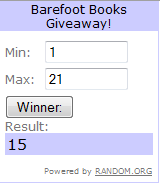
Barefoot Books Giveaway Winner!
Comment number 15 was left by Jen Blizzard who told us that a Barefoot Books story about her children would be titled 'Interesting and troubled Children'.
Congratulations Jen! I will be contacting you by email to confirm which title you would like to have sent to you!
Monday, May 16, 2011
Barefoot Books Review and Giveaway
We also took a moment to check out some of Barefoot Books free multi-media offerings. The YouTube channel was our favourite, it was full of colourful animations and catchy songs for Oliver to boogie to. There's even one about pirates. We like pirates! There is also a great collection of crafts, activities, and online story books, and a podcast that you can subscribe to!
Barefoot Books has generously offered to give away an item of choice to one of our readers. I couldn't be more excited about all that Barefoot Books has to offer. For any age group, any interest, and any occasion, it seems that Barefoot Books has a little bit of everything for everyone.


.jpg)